

This weekend, the U.S. government shut down Fable 5, the leading frontier AI model. The administration was motivated by domestic cybersecurity reasons, but chose export controls as an instrument to force this shutdown: it was the sharpest sword available to it on short notice. The effects on U.S. allies—fear, disorientation, alienation—were not only not the goal, but weren’t even seriously considered. In 2026’s AI policy, the rest of the world is so powerless that it can be cut off from frontier AI as mere collateral damage of domestic U.S. policy.1
Some international attempts to protest or negotiate betray a sad misunderstanding: ‘surely, something as bad for us must be about us in some way’. But the lesson from Fable is this: the American AI takeoff, from tech to policy to politics, is simply moving so fast that it is leaving the rest of the world behind. Now, I’ve cautioned not to overreact to the capriciousness of America’s adolescent AI policy, and I still think there are ways to rein this dynamic in. Countries can build leverage, adoption effectiveness, and secure access deals, draw the U.S. ecosystem into mutual codependencies and anchor it in the rest of the world. That remains our best shot at the best possible equilibrium, an allied world turning American AI into real-world abundance and wealth. But we must realise it won’t work in every scenario.
Because these days, if you can’t see the noose of a politically charged security apparatus wrapping around previously-abundant artificial intelligence, I’m not sure you’re paying attention. Increasingly, the frontier of AI capability is controlled by a maximally volatile version of the U.S. executive branch. Evidence is generated ad-hoc or perhaps deep inside the intelligence community, action is taken based on personal loyalties and with little respect for long-run consequences, decisions are biased toward immediate effects and domestic concerns. All this is carried out by an American presidency that considers itself a unitary executive that wields supreme power, and Congress is frozen into inaction by vociferous AI politics and institutional dysfunction. No interdependence and rational economic incentive truly binds this sort of administration—and so no ally can truly rely on American frontier AI.
Now assume another thing to be true: frontier AI really matters, the best systems are strategically and economically superior to the rest, and the resulting lead gives those at the frontier a decisive economic and military advantage. Frontier systems become so powerful that they threaten the sovereign state’s monopoly on violence, and that their owners become as powerful as any nation. In that world, you either own a frontier system yourself, or you are at the mercy of those who build, own, and control them. From that, any reasonable country would conclude that it simply needs its own frontier AI, however high the costs.
No one contests the logic itself. Critics of the conclusion, myself included, debate the premises: perhaps the frontier AI market will not shake out this way, and then fast-followers are enough; perhaps the U.S. will not be that unreliable and bilateral engagement can succeed; perhaps the technical paradigm will fail and alternative paradigms can catch up. But evidence keeps compounding in support of the worst-case scenario instead: the frontier really seems that important, and America really seems that volatile. In that world, if you want a sovereign strategy—not managed dependency, not a hedge, not a bet—the table stakes are clear: compete on what we know to work. Anything else is sovereignty theatre.

The Challenge
Competing on frontier AI on purely technical terms is difficult, and middle powers are not set up to do it at all—that is the lesson from years of failure to even get close to the frontier. Even firms close to the frontier are struggling, and in ways that make it clear they don’t see a business case in being second-best. xAI is now renting out its compute to Anthropic instead, and Meta’s Superintelligence Lab remains embattled by internal melodrama. But insofar as countries treat this as a strategically vital asset, the economic logic stops mattering to some extent. They need this asset to avoid unilateral dependency or entrenched vulnerability to anyone who does have frontier AI, economic rival or strategic aggressor. And genuinely willing nation states are powerful actors still: even today, they plausibly have sufficient energy, talent, funds, perhaps even semiconductors, to pull it off if they go all-in.
But even provided countries’ willingness, this is not only a matter of succeeding at the most ambitious infrastructure project in recent history. It’s a matter of succeeding at this project while under adversarial pressure from the U.S. and strict scrutiny from fickle electorates. No one voicing the ambition of reaching the frontier is grappling with that further challenge of insulating the project against American coercion and domestic backlash at the same time.
As a result, the debate about sovereign frontier AI remains unserious. The LinkedIn types and Euroboosters, stripped of real resources, are forced to pretend that you can build AGI in a coworking space in Stockholm. EU institutions voice lofty ambitions, just to shape them into massively underfunded subsidies for blue-skies research that would bear its first fruits after American superintelligence has already been deployed. And everyone who is aware of the scope of the challenge shies back from discussing it. Just seriously discussing middle power parity at the frontier has become the marker of a fool. But that won’t cut it anymore. If things continue down this path, sovereign frontier development might yet become the only play. I think we sceptics have dismissed that future too readily.
There are two ways to read the remainder of this essay; in fact, there are two audiences for it. One will read this as the plan: what we should really do if we only had the willpower, a document to send to your superiors and hope that, just maybe, the penny has dropped. The other will read this as a reductio ad absurdum: see, this is what it would take, and that’s why it would never work. Either way, all that’s left to do is to look at how we could pull this off. What follows is the middle power project.
The Coalition
Who would actually do this? No single country could. Because middle powers’ capital markets are too shallow, the financial burden needs to be borne by governments, and no government alone can fund this. And because the project might run counter to American interests, we should expect U.S. pressure, not only through AI-specific interventions, but horizontal escalation to domains like security cooperation or trade. Only a committed bloc of countries could hope to resist such pressure even under the best possible conditions.
I think a coalition of liberal democracies is most likely to strike the right balance between the required scale and cohesion. Among these democracies, calibrating a cohesive coalition structure is difficult. Forces pull in different directions: on one hand, many countries have something meaningful and valuable to contribute. Europe has a still-unrivalled economic, industrial and fiscal base, and, as the biggest established bloc, would be the obvious starting point—yet it lacks the assets that matter most: a frontier lab and the compute to train one. Canada and Britain bring technical talent, and Britain also offers state capacity; Japan and South Korea bring further economic heft and semiconductor supply chain positions; Australia, Canada and Norway could be attractive hosts for compute.
But internal strife is a large risk to a coordinated coalition. Alliance logic would have to structure around all its members’ contributions, and any of them falling away would add further volatility to an already-unstable constellation at a dire political time. Overextending the alliance in the abstract early, considering members that are not fully bought in, only to lose them later is a very dangerous prospect. That’s especially true given U.S. incentives to bilaterally target single participating members to get them to defect. If America offers massive datacenter investments and a broad exemption from export controls to one of its close allies—say, the UK, which seems most likely to clear the bar on security and alignment—can you really count on them refusing? Would they even opt in to begin, or decide to try their luck with bilateral U.S. engagement for now?
Based on my understanding of the state of the bilateral relationship and the need for security guarantees, it strikes me as unlikely that South Korea, Japan, or the U.K. would reliably join a coalition for middle power AGI. But these things are downstream of domestic politics, and bilateral relationships deteriorate faster than you think—just look to Canada. Who knows who would join after another Fable episode or two? The coalition could expand and admit further participants at a higher price of entry if the worst-case trends in U.S. AI policy continued to unfold.
So, the likely cast of value-aligned governments with substantial contributions to make that you can get together on short notice is the EU, Canada and Australia; with a warm invitation extended to the U.K., Japan and South Korea for whenever they’d like to reconsider their American alignment, and cooperation offers made to the usual tag-alongs of Western alignment like Norway, Switzerland, or New Zealand. Defection, of course, remains a risk even in that cluster, as America has strong incentives to buy off and buy out the participants. One way or another, the coalition will need a strong, binding commitment mechanism; perhaps the easiest technical (though politically difficult) path would be to precommit a majority of the resources—funding, talent, infrastructure access—in a way that cannot simply be clawed back by a defector. Further interested middle powers beyond the close alliance could commit funding in exchange for guaranteed access rights one rung below the coalition members, but should not be afforded full constituent voting rights, in an effort to keep the decision-making process somewhat effective.

The Vehicle
Once that coalition is assembled, what would the actual vehicle be—would it be a private company, a nonprofit, a government agency, a consortium of sorts? The answer is yes, it would need elements of all of these: a private vehicle that draws resources from a consortium of legacy firms, corresponding with government agencies through a layer of special appointees.
The coalition does not have the luxury to rely only on pure private sector champions. Even in America, the trend is moving toward stronger government involvement in the AI labs and their decisionmaking, and America has the advantage of a vital and well-capitalised private ecosystem to begin with. Our coalition does not have the same market structure, and neither does it have the benefit of time. No venture market in the coalition—nor all of them combined—could carry a project at this scale. Most of the burden will fall to the treasuries.
And a speculative private enterprise alone, listed in one country, suspected to simply be chasing subsidies and profits, cannot rally the kind of governmental support that will be required. And last, if we really do face the securitised future of American AI, by the time that Europe finally has its private sector frontier champions up and running, America will already have furthered the soft nationalisation of its own developers through taking equity stakes and deeply interlinking labs with its intelligence community, and our private sector would be left racing against the U.S. government.
No—this needs the full backing of the coalition countries, including the full support of their national security authorities in protecting the project, the full support of their trade authorities in securing the supply chains, and the full support of their treasuries in financing and backstopping the various expenditures we will require later on. Most of all, it needs the broader geopolitical weight of a coalition.
Institutional Design
The vehicle to execute the project itself would need to be structured like a private company: a highly powerful leadership group chosen on the basis of exceptional demonstrated research taste, an ability to stand up and scale up huge organisations, and an ability to communicate with funders—which in this unique case largely means communicating with a broad range of governments. The structure below this team of co-founders would largely resemble today’s most successful frontier AI developers. We do not have the luxury of experimenting with new formats: this is the only structure we know can make frontier AI models, so if we bet big, this is the structure we have to deploy. I expect the question of where the vehicle is based to be politically sensitive and the result of difficult negotiations. It’ll be spread across different cities to accommodate talent incentives and reduce lump risk in one jurisdiction. That also has the benefit of spreading out the second-tier effects of the project, like stimulating effects to tech ecosystems, or taxable revenue from salaries and infrastructure.
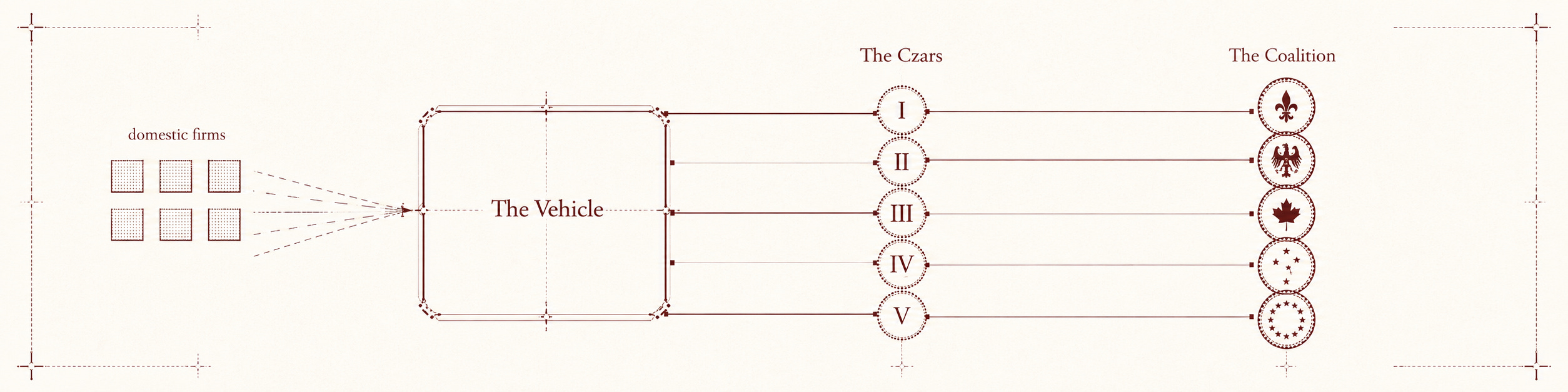
Into this vehicle, existing teams from any interested domestic champions can be appropriated and absorbed, though with little respect to their current institutional structures. Organisations like Mistral and Cohere/Aleph Alpha, as well as various narrow champions like Black Forest Labs or ElevenLabs are valuable concentrations of talent and initial expertise. But there can be absolutely no over-indexing on their preexisting structure: regrettably, these companies have not been able to reach anything close to frontier parity, and so in the interest of the project’s success, we have to consider them an insufficient model. More to the point, they’re also an insufficient attractor: top-tier research talent will not believe in a continuation of what many of them perceive to be failed players, even if they share their ambitions. For better or for worse, the legacy brands of middle power AI have lost their credibility, and so they cannot serve as the basis for the project. Buying out roughly half the sector—the structures, IP, data, and teams worth having—at near its current valuation perhaps makes up for $25 billion of the total cost.
Since the vehicle will require massive government support and should be responsive to government interest in its approach to public policy, safety and national security, there will have to be a complementary government structure. This structure should be entirely separate from the technical operations of the vehicle itself, lest bureaucratic torpor drag down the project and turn it into a government initiative. What I’d suggest is that each participating country designate a ‘project czar’. Czars are senior domestic policy figures at a ministerial or state secretary rank, convinced of the viability of the project and somewhat adept at navigating their respective domestic political institutions. These czars are provided with high-calibre teams of frontier policy operatives, similar in shape and makeup to the U.K. taskforce that became the world’s first AI safety institute. Czars and their teams are liaisons between the project and its constituting governments: they own all communications, translate technical language into government language and back; make sure the project understands when it brushes against non-negotiable policy imperatives and make sure the governments understand when it comes too close to impeding progress. This is an enormously important part of this project: if the government links work well, chances are much higher that political backlash can be contained and defection risk can be minimised.
Capitalisation
Once this vehicle exists, it needs to be equipped with sufficient funding. To give a realistic sense of the challenge, I’ll do my best to give you an informed guess.
As a rough approximation, the project might cost $500 billion over four years.
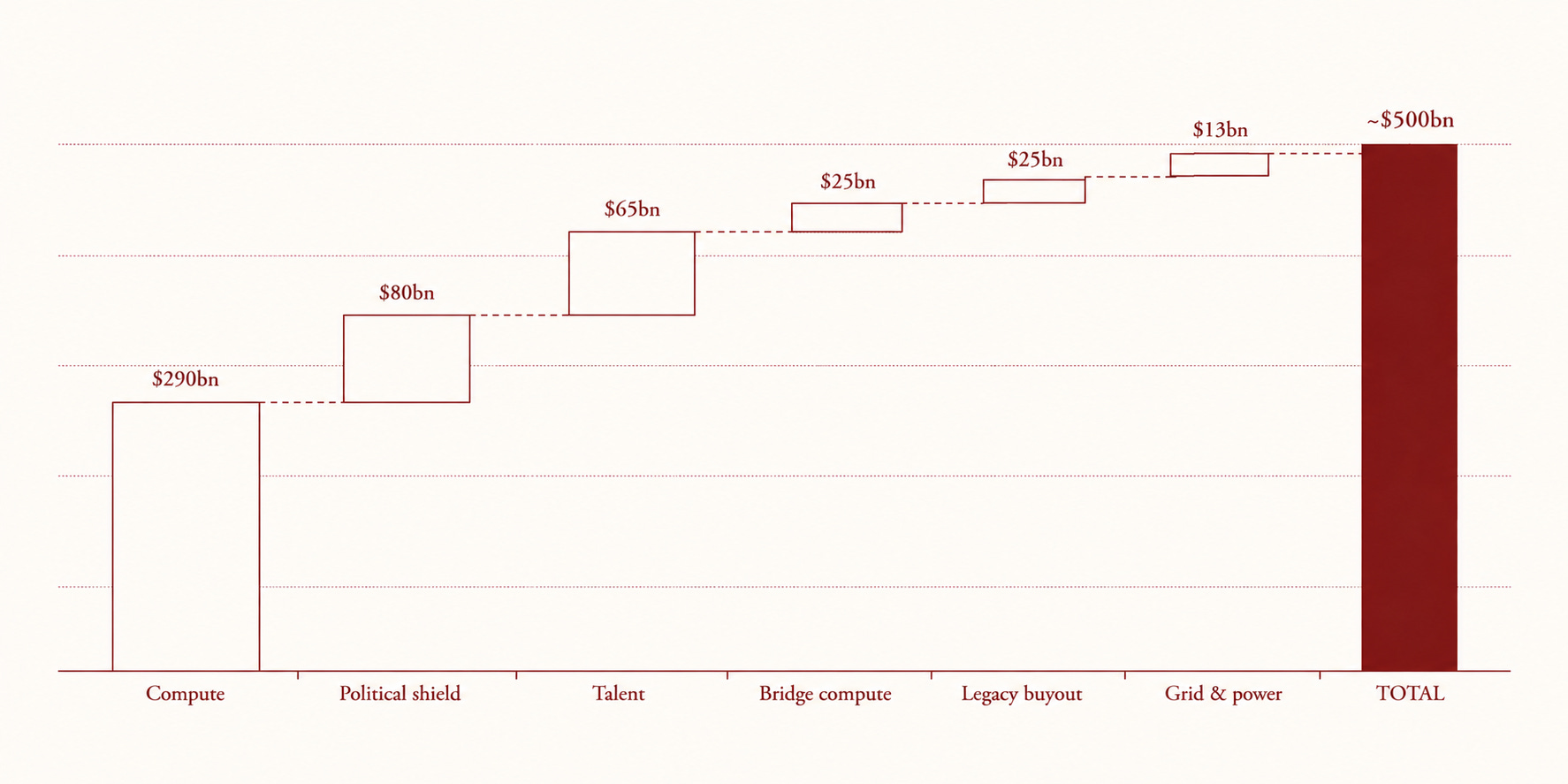
Getting this money is technically simple and politically difficult. Treasuries have deep pockets, middle power debt capacity is still large, and one would have to hope that the product eventually yields revenue. Until then, treasuries, pension funds, wealth funds and so on will simply have to find legislative and executive ways to backstop private sector investments and provide outright funding where necessary. Hopefully, the project would manage to crowd in substantial private sector investment eventually: legacy industries in middle powers have deep cash reserves and a desire to gain exposure to AI, and could perhaps even be offered exclusive access, product fine-tuning and much more in exchange for contributions. But the coalition should not count on abundant private funding—the expectation should be that the treasuries need to bear much of the initial four-year cost.
The upside of this capitalisation approach is an Airbus model of strategic ownership: the public carries all the early strategic risk, but in return also owns the resulting frontier lab. Frontier labs tend to be worth quite a lot of money, and the sovereign equity this project might generate would be enormously useful for government financing later on. In effect, the project sets up a volatile, overconcentrated sovereign wealth fund instead of just being a pure waste of money. If the project succeeds, the company can be partly privatised to the European market at strategically acceptable levels of private ownership, making for some belated cash backflow to any treasury interested in doing its own mini-IPO. In turn, limitations on clawing back your equity too early serve as a commitment mechanism: either you see the project through with us, or you lose your initial input.
In that light, the overall price tag is substantial but not insurmountable. It is not dissimilar to what countries like Germany have taken on in special debt packages before, and it would be distributed across a much broader coalition. There’s not much to say about the specifics: this is doable immediately, but only through leaders who decide the trade-off is worth going for.
The Compute
Building frontier models is extremely resource-intensive: the buildout in the required computing power has given rise to the world’s most valuable firm and is shaping up to be the largest infrastructure push in human history. Middle powers have often taken to the pernicious illusion that they can instead sidestep some of this effort—maybe you could find a new paradigm, for instance, or make progress on ‘world models’ (though no one seems to agree on what that’s supposed to be). I think these hopes—as embodied by prominent labs like Ami and LawZero—are not entirely misplaced, but they’re long shots: they might or might not find a new paradigm, and it might or might not be competitive at the frontier of the most important tasks. And they face structural disadvantages: if there is a mold-breaking approach to be found, chances seem high that a compute-rich frontier developer with all its talent would find it.
Paradigm-shifting bet is a fine part of a broad portfolio, but insufficient for what we are talking about here: a project with a clear path to a strategic payoff that’s legible even to sceptical policymakers and conservative treasuries. There’s only one paradigm we know can get to the frontier, so that’s the paradigm we pick.
The Price Tag
If this project is to compete on anything near the current paradigm, this project will need compute. There are two figures to benchmark the ballpark against. First, the good news: the project needs somewhat less than an American AI developer over the same time because there isn’t quite as much inference to run for most of it; American developers need to balance training and profitability in a huge market, while the project might be free to research and develop for a while. Comparing hyperscaler spending to the cost of this project is therefore misleading. American big tech needs enough compute to provide software to billions of people; the middle power project, especially in its early stages, does not.
Then, the bad news: the frequently invoked figures for training costs in Chinese models like Kimi K2 or DeepSeek R1 are also wildly misleading. Even if it is correct that the final training run for a model in 2025 only costs a few million dollars, three factors massively increase the compute draw beyond the actual pre-training run for the frontier model. Specifically, the project needs far more compute for internal deployment of its own proprietary coding agents to accelerate its research; for R&D experiments required to reach and further the frontier; and for pre- and posttraining at scale, which has become much more expensive since 2025.
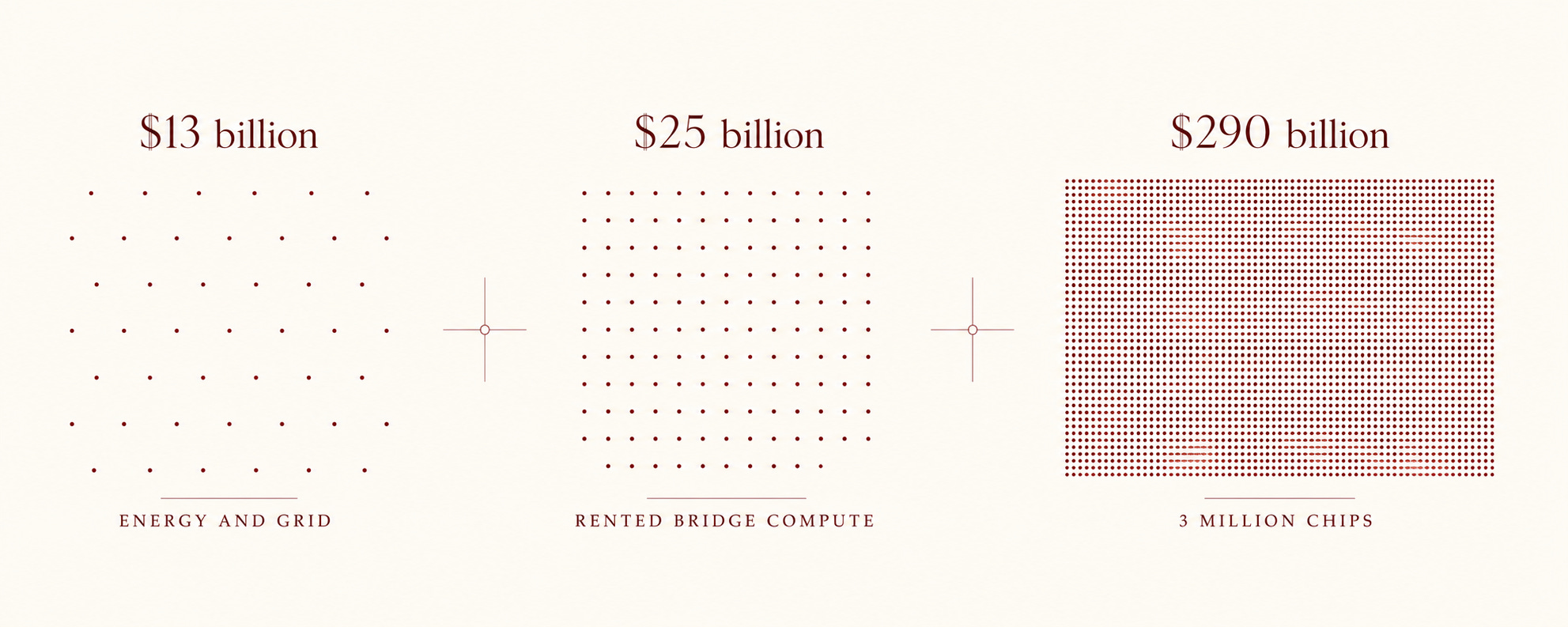
I’m not an expert in the semiconductor and datacenter discussions that follow; my numbers might be off by a lot, but I feel reasonably confident they are within the right order of magnitude to grasp the underlying strategic dimensions. My best guess is: the project might need as much as the currently-scheduled compute buildout for one major American lab. The project needs less inference than that developer, but perhaps more R&D; and I also assume that American labs will add further compute over the next few years beyond what is already planned. If that is true, the project would at least require about 3 million Blackwell-class chips over the four-year build, equivalent to roughly 5–6 GW of all-in datacenter power, and might plausibly cost around $275–300 billion to buy and put into somewhat secure datacenters. That runs more expensive than what hyperscalers pay for the same chips, but we need to price in our project’s relative inexperience in building the datacenters—which will require paying a premium on datacenter construction expertise—and the pressures of entering into an already-contested compute market.
Building Out
The playbook for getting this compute online has been written a few times at this point. My colleagues at the Carnegie Endowment have published a comprehensive report on compute buildout in middle powers just last week, and others have done good work on this. The short version is: you pick a combination of middle powers good at building compute for different reasons and push aggressive buildout projects in each of them. You go for a combination of host countries that can go fast so you can commence the actual work as early as you can, and host countries that can go broad so you can actually get the compute depth you need without running into bottlenecks. You probably slightly expand the compute host list based on political considerations—some treasuries will want the investment to be local, some countries will want local instances of secure datacenters for national security exercises, and so on. This is simply an industrial megaproject—difficult, but difficult in well-understood ways that middle powers have sometimes navigated in times of crisis before. As late as 2022’s gas shock, Germany—famously NIMBY-rich and laggard in infrastructure—managed to build LNG terminals within 10 months.
The same is true for the energy required. Among the middle powers, there still are available energy solutions to get datacenters online quickly: renewable mixes in Australia, Scandinavia and Iberia; nuclear-powered main grid capacity in France, Finland and perhaps Korea or Japan; deindustrialised high-power zones in Germany and perhaps Britain. Spread the compute between those, and the scarcity in behind-the-meter generation capacity will not be an immediate problem. Still, the project would be a drag on the grid and on overall energy supply, and it will have to make up for it by building out at least some proprietary capacity in the long run; I’d expect us to have to calculate something like $3 billion for energy opex and another $10 billion for grid improvements and power generation capacity.
In the meantime, there will be a scramble for rental compute available before the clusters come online. Two measures in particular would be necessary: consolidating government-owned supercomputers and repurposing them away from the research ecosystem that currently uses them and into the project; and scrounging the spot GPU market for any rentals available. Between expropriating and renting the supercomputers and renting whatever compute we can get in a competitive market to accelerate the start date, I’d expect to spend about another $25 billion—rented frontier compute is very expensive, with Anthropic alone paying $1.25 billion a month to rent xAI’s Colossus cluster. That way, the researchers can commence work on day 1, with a smooth on-ramp into more R&D compute than would be available at a major frontier lab.
Acquisitions
That is, believe it or not, the easy part of getting the required compute. The hard part is buying the chips without the Americans intervening. The Trump administration is capable of remarkable feats of inconsistent policymaking—but surely even they wouldn’t simultaneously decide to export control frontier models, but still allow the unrestrained exports of frontier chips to a middle power project explicitly aimed at creating the same frontier capabilities outside the US. And export controlling chips is very easy: there are enough American buyers, the authorities are in place, the supply chain is entirely concentrated through an American firm.
You’d think the same concerns would apply to exporting compute to China, and yet the administration has been hesitant to restrict that flow. The reason is that, with China, the U.S. concern is fuelling indigenisation by forcing Chinese industry to catch up on semiconductors, making them less reliant in the long run—which means it’s possible that the U.S. might choose to export to China, but not to its allies. The main unofficial reason for exporting to China, however, is that Nvidia likes money and a diverse pool of buyers. That reason does translate to middle powers, and it’s the strongest asset on their side: if Nvidia likes the project, perhaps Nvidia can get the U.S. government to hold off on sabotaging it. There is an uncomfortable analogy to being cut off from AI models here, but there are also differences: chips are not directly harmful in the same way as frontier models, so it’s more difficult to evaluate them for risks wholesale; believing they will be risky requires believing in the success of the project itself, which I assume many Americans will not take seriously; and of course Nvidia is much more influential with the current government than, for instance, Anthropic.
That alone might not be enough. At some point, Nvidia’s influence might wane. Or Nvidia might genuinely not have enough chips to cater to all their premium customers at the same time. And once the project starts succeeding, the U.S. government might start having second thoughts about the security implications: if intelligence agencies are getting worried about the proliferation of advanced AI capabilities, they might lobby to put a stop to further compute exports very quickly.
The Coercion Shield
This is where the middle powers’ own semiconductor supply chain leverage comes in. Under normal conditions, chokepoints are only of limited use. But in the context of the project, semiconductor bottlenecks can be used as an anti-coercion instrument: if America attempts to stop the sale of chips to the project, the project in turn restricts resources—EUV machines, raw materials, memory chips if East Asia joins—that the Americans need to develop AGI. I think this tactic is more promising than the usual ASML bluster for two reasons: it is deployed in a context with broad, coalition-wide opt-in from all middle powers, and it is not only aimed at the U.S. government, but at Nvidia, which much more directly depends on access to upstream semiconductor inputs to stay in business. Deployed right, the coercion shield enlists Nvidia as a US-internal advocate: it gives Nvidia everything they’ve ever wanted in terms of avoiding monopsonies and supply chain bottlenecks, clarifies the alternative of a chip market crash, and shows the easy way out of continuing to sell chips.
The ask is also fairly modest by itself: all the leverage needs to do is convince the U.S. that it’s the path of least resistance to continue allowing the export of U.S. chips into the project—no major interventions into U.S. domestic industry required. Neither the U.S. nor the coalition has a sovereign semiconductor supply chain by itself; leveraging that fact accordingly at least increases the odds of retaining uneasy mutual access. Fundamentally, the coercion shield trades on the assumption that the Americans will think themselves ahead, and would rather tolerate a European project they dismiss than a risk to their own AGI supply chain.
This might work, but it’s a highly risky bet: the coercion shield takes some of the biggest existing sources of leverage and economic participation the coalition has, and it spends them on protecting the project instead of securing access, playing the U.S.-China dichotomy, or anything else. That is another way in which the project represents a full all-in—putting all middle power AI assets into the basket of actually pulling it off. But without a coercion shield, the project would crumble under American pressure before it even had the chips to launch.
The Talent
Once you have the chips, you need someone who knows how to use them to make frontier models. Specifically, two types of talent matter. The leading group of founders needs to be made up of truly exceptional talent that strongly identifies with the project; and the larger group of engineers needs to be up to the standard of the task, and, most importantly, largely consists of former frontier lab employees.
Talent as Industrial Espionage
The latter part is vital and frequently misunderstood. Hiring ex-lab employees is not just a way to get good engineers on board, it’s a well-practiced form of basically somewhat legal industrial espionage. The current dynamic of leading researchers switching teams is part of the American frontier labs’ homeostatic balance: they take practices with them, deploy them at their new employers, and no secret stays secret for very long. Within that fact, there’s a source of hope and a deadline for middle powers at once. A source of hope, because you do not have to start from scratch: if you win over a cadre of high-calibre researchers, they can deploy a lot of quasi-proprietary techniques to get the project started. But a deadline, because this channel could close soon: labs are increasingly siloed, advances in internally deployed AI systems make information exchanges less necessary, and so poaching researchers will become less and less effective.
Recruiting
The fundamental logic of pulling off the recruitment is very simple—I’ll spare you the incentive structure analysis and just broadly give you the following: to recruit frontier lab researchers, you need an interesting challenge, a mission they can believe in, and compensation high enough that joining is attractive rather than suicidal. The latter part is in conceptual ways the easiest: you need to pay them as well as they are paid at the American labs—but you need to factor in lab equity, because a European project is a much less promising IPO prospect than an American AI company. All in all, I’d expect the cost of poaching sufficient senior talent for an effort like this to be close to what Meta was reported to be spending on top researchers, with individual senior pay packages in the tens of millions, plus obvious perks like fast-tracked visas.
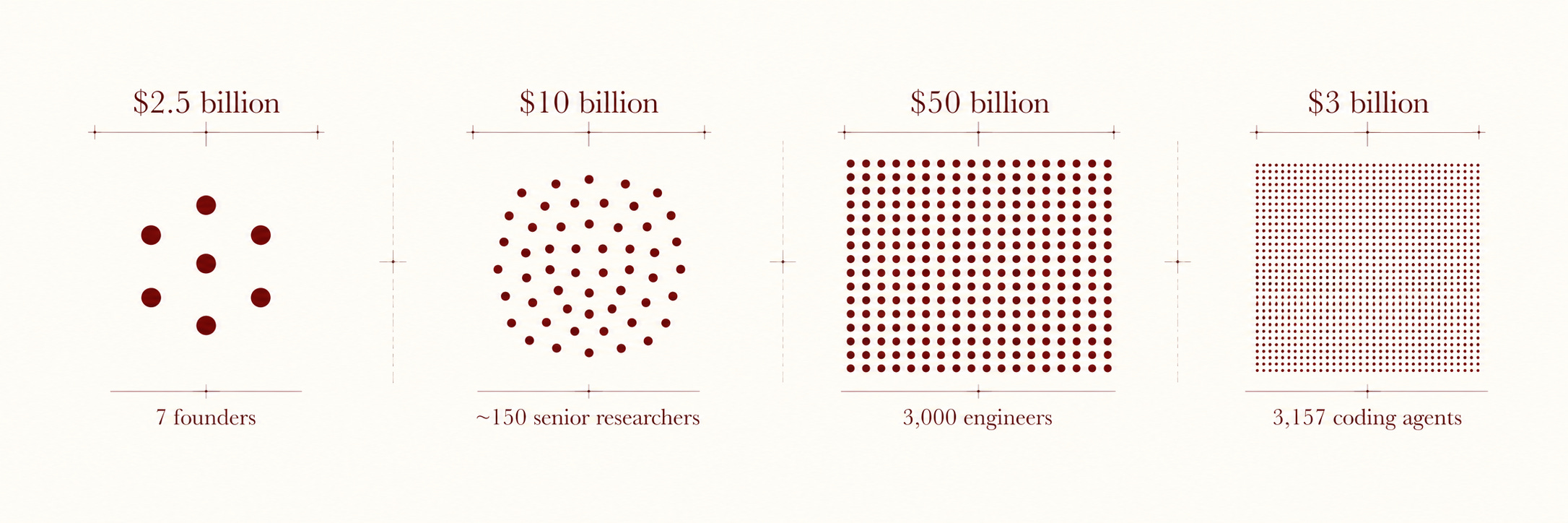
Across the project, the personnel bill runs to about $65 billion, in three tiers. Indulge my speculation as justification not for the figure, but the order of magnitude. First, a founding group of perhaps seven, distributed across participating nationalities, of the calibre that currently co-founds a frontier lab and is wealthy on paper through its equity. They would need guaranteed packages in the hundreds of millions each to make walking away rational, call it $2.5 billion in total. Second, a senior research cadre of around 150 on Meta poaching terms, $5–8 million a year apiece, each clearing into the tens of millions over the life of the project: perhaps $10 billion over the four-year build. Third, a technical corps of perhaps 3,000 staff—lower than frontier labs in the mid-thousands, but justifiable because of the product-related functions the project doesn’t yet need. These will be more expensive for the project than for a frontier lab: we have no IPO and no equity lottery to dangle, so we pay in cash what the American labs pay in stock, perhaps about $40 billion for the entirety of staff. We also have to buy out the unvested frontier-lab equity each hire forfeits on the way in, which I expect to cost at least another $10 billion up front.
As for the mission to believe in, I suspect the most effective way to create that is to empower and recruit respected leaders. Researchers—correctly—assume that the success of a project depends on the research taste of its leaders, and the extent to which these leaders will be able to act on what that taste suggests. The first step of the project would therefore be to approach these leaders. I suspect many middle power nationals with some patriotic loyalties on the lookout for a new challenge exist, and if the coalition was to approach them with a real commitment to enable their work and secure their independence, they might just be interested to join. From there, the founders are the project’s main ambassadors to the research community: they sell the vision, relay the commitment made to them, and get the teams on board.
Non-Human Talent
Most workers at a frontier AI developer in 2027 will not be humans, but AI agents. Already now, these AI agents do much of the actual work in a lab: they write and run the code, communicate the findings, and fill out the forms. The human talent is mostly responsible for coming up with ideas, taking meetings, and switching the model back to Opus when Fable gets cut off. Getting access to these AI agents in the early stages of the project will be the most difficult part of recruiting. Already today, Anthropic has limited the use of its most advanced models for frontier LLM development; it doesn’t seem absurd to think that its competitors might follow suit. Because the project would not have its own frontier model from the start, it also would not have its own frontier coding agents from the start, massively slowing down its progress—in effect hamstringing the nonhuman part of its workforce substantially.
Luckily, this problem resolves itself as the project takes off: once it builds its own coding agents, it can deploy them internally, and hopefully the external dependence diminishes. That is, incidentally, another reason why a sovereign frontier developer might be the only stable sovereign project: an eternal fast-follower will never have sufficient internal coding agents to keep up with compounding gains at the frontier. Securing coding agent access is hard but not impossible—perhaps, for the time being, OpenAI wants to brand itself as less inclined to sabotage competitors than Anthropic and therefore sells a big coding agent contract. Or perhaps we can simply offer an attractive deal structure for the first year or so, before the U.S. government takes note that the project might actually succeed. If we do well enough on compute, we can also offer to run some of the foreign AI agents ourselves, further increasing the financial incentives for the U.S. labs to give us access. Expecting to pay a hefty premium, we might plan to spend $3 billion on foreign AI agents over the first 18 months.
Staying Alive
Once all these assets are in place, the climb toward a frontier system starts. It will be slow and arduous either way—slightly faster if you have unlimited access to U.S. compute and coding agents, much slower if not. But within months of the first clusters coming online, I’d expect a first rudimentary model a few months behind the frontier to be produced. If things go well, I suspect that within, say, two years of its launch, the project might be able to actually deploy a frontier model.
Within that time, the project is politically vulnerable. The opening motivation will dissipate as time goes on. Single members will try to defect. AI, as a technology, will itself grow more and more unpopular, labour impacts and misuse risks will manifest. Not every contributing country will be excited to see its resources flowing into reaching frontier parity if the frontier itself is what is scaring their electorate. It seems impossible to game out a response to this threat in detail, but it’s the biggest uncertainty in this entire process. The naive response of a well-capitalised project is to buy them off ahead of time: ratepayer pledges to constrain individual effects of energy prices, direct AI dividends to anyone asymmetrically affected by the project’s progress, industry electricity price subsidies so that compute buildouts don’t trade off against legacy interests, and host-region payments to guard against local datacenter backlash. I expect the political insulation to require what is effectively a package of bribes on the order of $80 billion—but as with many investments in this list, these are incidentally also somewhat defensible instances of government investments that some middle powers have been considering anyway. And put side by side with hundreds of billions middle powers have spent shielding their economies from Covid or energy crises, the political shield seems outright modest.
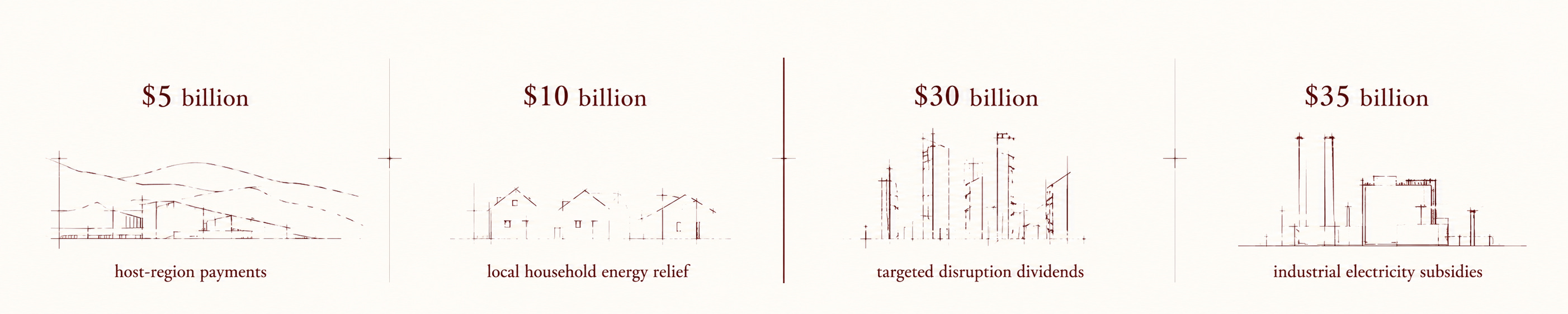
The other part of the response is that the project will have much better political appeal than American AI developers: because the project does not face the same kinds of economic pressures to compete for consumer markets and investor stories, many of the most socially corrosive and politically vulnerable application areas (such as rapid labour market uptake, addictive use cases, or child safety issues) aren’t visibly connected to the project, just to its American alternatives. Between these two saving graces, we’ll need a lot of good comms work—but there is some hope that the project is structurally less vulnerable than its current American version.
Productisation
Make it through all this, and you finally and ultimately get a frontier system. That helps for about three months. But the American AI developers are not just frontier laboratories, they are also sophisticated and capable product firms with deep inroads into consumer markets and a wide roster of extremely revenue-rich business contracts. Building a frontier model is viable for them because the returns to being in the lead are enormous and can be reinvested into staying at the frontier. No European firm has the same market or sophistication available to them, and it has in fact been a perennial failure mode of non-American firms to scale at a similar level of ambition.
To begin with, the project would be the main frontier AI provider to coalition governments and high-security private applications—perhaps even by necessity due to U.S. models not being available. Beyond that, the coalition might have to take protectionist action to encourage its private sectors to use the project’s models even where American alternatives are available. There is some economic risk to that, but it is also the only way to kickstart a flywheel between the coalition’s critical industrial capacity and the project. Without a genuinely ambitious project, that’s a recipe for disaster because it compels firms to use a sub-par economic input. But if the project itself succeeds, its privileged access to what would be the largest market in the world could entrench it as a viable economic actor. And then, if the project succeeds in developing a serviceable model, it can begin competing for global markets. There, it has a distinct advantage, as it squares off against capricious Americans and Chinese alternatives widely seen as untrustworthy.
All that is its own challenge—building a successful frontier AI business is even more difficult than building frontier models. In the beginning, we should expect to subsidise the project and its ability to continue providing frontier AI for the foreseeable future, and consider it an expensive investment into a vital defence contractor, with an option to become a breakout economic success. But the upside potential is still high: done well, the project has a greater claim to political legitimacy than the American developers, and a greater claim to international reliability than either of its competitors. If you think breakneck competition with China and domestic political backlash are the greatest risks to the American labs, you might look at the project and think: maybe it could not just survive, but win?

Half Measures
Vapid inspirational quotes will tell you that if you shoot for the moon and miss, you might at least end up among the stars. Yet in AI, if you shoot for the moon and miss, you end up with a subsidy-chasing fast-follower instead. If a sovereign development project does not succeed at developing a frontier model, it is not worth pursuing as a response to our initially outlined challenges at all.
The impulsive reaction to all of the proposals above will usually be ‘well, this seems a little bit much’. The sentiment will be: yes, we have an interest in sovereignty and some spending to mobilise, but surely this is the radical starting position, and we can actually find a reasonable compromise at a fraction of the cost here. That attitude is the standard operating procedure for the European Commission in particular, which has time and time again taken good ideas—like the Gigafactories or the frontier AI initiative—and watered them down until they’ve become unrecognisably unambitious. In this case more than in any other, that impulse is fatal: either you do the fully ambitious version of this, a version you can honestly believe might make it to the frontier, or you might as well not do it. You might see just how unsatisfying the second-best outcome is by looking at the second rung of AI developers today—some of them do fine on short-term revenue, yet clearly none of them have the standing of genuine strategic assets even to their home countries.
In this case, the frequently-invoked little brother to the project is to create a ‘fast-follower’ instead. A fast-follower is an AI company that consistently stays some amount of time behind the frontier—it’s what Chinese developers and Europe’s Mistral have tried to differing degrees of success. But a fast-follower is fundamentally a solution to a very different problem: it supposes that there will be a visible frontier, it will be cost-effective to chase it at a stable distance of a few months, and that the model that results will be useful. But think back to the top, to our Fable scenario: a world where the United States security apparatus tightly controls and only sparsely distributes critical frontier capabilities, and where those capabilities are key inputs into vital economic and strategic functions. If that scenario is true, a fast-follower doesn’t help: the visible frontier is far out of reach and difficult to emulate, and second place is no consolation. If that scenario is false, I struggle to see why you’d even need a domestic fast-follower at all. If access is not locked down, then surely you are just better off importing the models instead, not bearing any of the huge costs outlined above, and investing into more effective adoption and downstream value capture instead.
Worse, fast-followers might become less and less feasible the more important frontier AI becomes. As the closed frontier, available only to the U.S. government and perhaps privileged buyers, becomes less visible to everyone else, it becomes more difficult to emulate: followers cannot distill it, and they cannot even guess at the shape of state-of-the-art models from using them and observing their performance anymore. And the further the limited frontier is from the commercially available frontier, the more AI asymmetrically accelerates the incumbents: if Anthropic’s coding agents are much better than external coding agents, Anthropic will be much better at growing the gap.
There are, admittedly, pleasant things about having your own fast-follower. Fast-followers like the Chinese open-sourcers hurt American developers’ leverage a bit, provide secure and privileged access to models in domains where the frontier does not matter, allow unlimited specialised posttraining for applications where you don’t want to share your approach because it’s based on privileged data, for instance, and so on. If it’s possible as a matter of economic policy—not a big consolidated project—to encourage middle power fast-followers, I think it should definitely be done.
But all of that deeply, fundamentally misses the point, which is simply this: usually, middle powers are not well-positioned to develop AI models. They should attempt to do so under extraordinary circumstances of geopolitical need. And it is precisely under dire circumstances that a fast-follower does not cut it and a frontier model is needed instead.
Where to Begin?
Where does all that leave us? Between two worlds, I think. One is the world of ‘what should be done under certainty and perfect conditions’. In that world, the project I describe is the only thing worth doing, and we need to start working on how to pull it off. In practice, that would mean that in many rooms at once, conversations would need to start. Researchers in San Francisco meeting after work to assemble teams, world leaders huddling on the sidelines of the G7 begin forging a political consensus. Teams in capitals are springing into action and standing up taskforces. AI experts hailing from middle powers, but now in American exile, start work on Signal groups and Google documents gathering names, contacts, funders, ways to make this work. Things move fast, but under the surface. The project grows together from both ends: the governments mobilise their motivation in the abstract and start reaching out into the AI world, and the AI world rises to the challenge and offers them a blueprint to work with.
That’s not our world. Instead, we live in the world of political realism; a world that knows just how embattled the resources required for the project are. How rare political ambition of that scale is in the Western world, how scarce energy and public funds already are. And how uncertain that specific future of the highly securitised, weapons-grade frontier still is. In that world, putting an actual, honest price tag on AI sovereignty makes you realise how unlikely it is to happen.
Trying to achieve AI sovereignty is to ask the most structurally conservative governments in the world to hinge their fiscal credibility and political fate on what they still consider a highly speculative technical bet. It’s going into cabinet rooms and asking for 500 billion dollars. In the real world, none of this will happen. Perhaps with a sigh of exasperation, you close this tab and return to the political reality of middle power policy. The rest of the world is and will remain behind, but we can manage the dependence. We forge access deals, attract U.S. investment, drive ahead the integration between domestic industries and foreign model providers. It’s a bet, but it’s a decently hedged bet for now: perhaps the market trends favour the effective adopter, perhaps the gains diffuse broadly. Perhaps serious middle power contributions have the U.S. reconsider the question of alliance-wide alignment, and the American project can come to benefit the world’s democracies as well.
But no matter how much progress we make in that real world, our fate will never quite be in our hands. When we wake up in the European morning, we’ll still check our phones and see what the American evening has brought this time: do we still have access to leading artificial intelligence? Are our systems still secure, are our firms still online—are our citizens still safe? There will always be that uneasy feeling, gnawing at our confidence in piecemeal progress. If we were truly serious, wouldn’t we launch the project instead?