

Anthropic does many things well. It’s a leading frontier AI developer, a premier source of information on the uses and effects of advanced AI, a powerful voice in policy debates, and a political outlier in a Silicon Valley increasingly aligned with the GOP. But as AI policy grows more complicated, deeper conflicts are opening between these roles – conflicts that ultimately put all of them at risk.
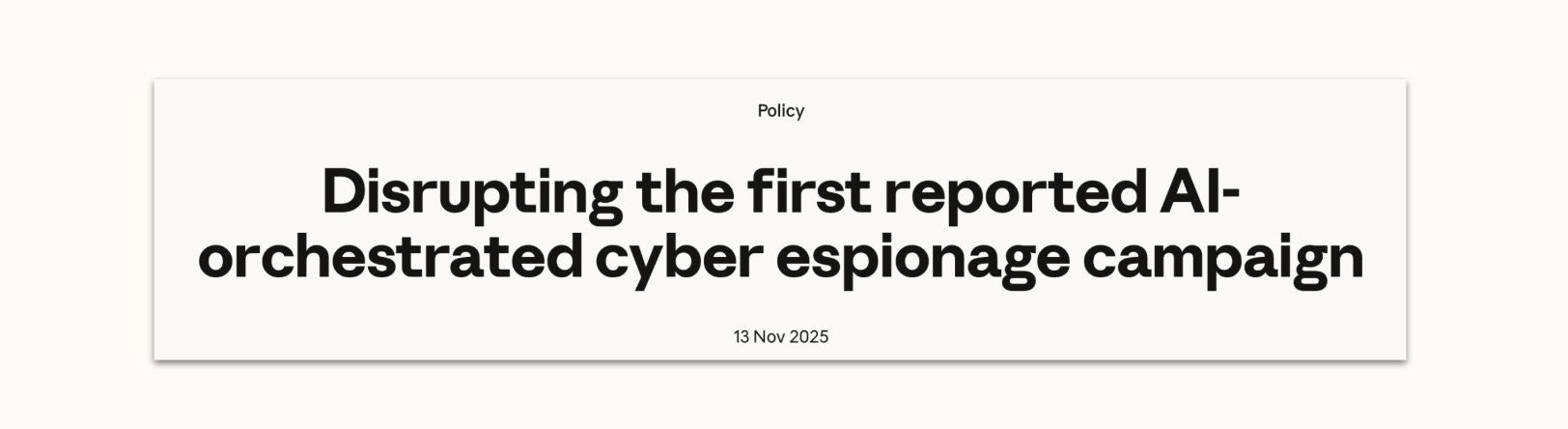
In the last few weeks, some fault lines have started to show. In quick succession, three separate events left some with an impression of agenda-driven behavior, incurring public attacks on Anthropic’s broader credibility. First, Anthropic provided industry support for SB-53, a California law mandating increased transparency from frontier developers. Second, co-founder Jack Clark spoke to a broader political strategy: create transparency into frontier systems, then leverage the findings for further policy asks. Third, Anthropic released detailed information on a cyber espionage campaign conducted through Claude Code.
Critics cried foul at each in a manner that I thought slightly missed the point. It seems to me like each of these decisions was made on its merits by well-meaning individuals. The suspicions around the transparency strategy especially seemed somewhat exaggerated: if you genuinely believe something to be dangerous, it follows that more information would advance your regulatory agenda – no fearmongering required.
But there’s a real problem here: it’s becoming increasingly difficult to square the many roles Anthropic is trying to play. If you want to be the neutral lab that can authoritatively call warning shots, it hurts to be on record pursuing controversial policy goals – people will discount what you say. If you want your support of transparency regulation to count as an industry endorsement, you can’t run too far ahead of the rest of the industry in publicly communicating your political strategy. And if you want to distance yourself from the Trump administration more than your competitors do, your short-term influence on any of these goals will suffer.
The underlying tension, then, is that Anthropic is very good at identifying what voices the ecosystem needs, but is beginning to overextend in trying to fill all of them. Taking stock of these roles might help find a path forward. In my view, that leads to a clear conclusion: to maintain its unique value as a trustworthy voice on AI effects, Anthropic might have to cut back on some political positioning.

Four Roles
So what are these roles Anthropic seeks to play? The first non-negotiable is that Anthropic intends to remain a frontier AI developer. I know that some old-school safetyists consider this contingent and perhaps even offensive – there are some arcane documents suggesting that Anthropic should not be involved in pushing the frontier – but I think it’s simply a reality of the day. To stay relevant to any conversation, a company has to stay at the frontier – particularly when it doesn’t have the market capitalisation of a tech giant just yet. Anthropic’s credibility and relevance, its ability to stay in the room, depends on continued frontier performance, and so that’s a given.
Neutral Authority. Anthropic seeks to be a neutral authority on the effects of advanced AI: an organization with exclusive insights into what AI is doing in the real world, communicated diligently. This is something Anthropic does quite well. The cybersecurity report is a recent example, but Anthropic is also far ahead of the field in other issues, most notably on economic data and transparency in safety research.
To my mind, this role matters greatly. On both the economic and safety fronts, we consistently lack live information on what is actually happening. Smart policy ideas are consistently bottlenecked by uncertainty around what the actual targets are, good politics are hamstrung by empirical disagreement. Data is an antidote – tracking usage statistics is valuable for calibrating labor policy, and even controversial safety research helps continue the technical discussion openly, grounded in an understanding of actual frontier capabilities.
Most importantly, a frontier lab as neutral authority is one of the very few actors that can credibly call a warning shot. This is a favorite pathway to political salience for many safety advocates: a large AI risk manifests early in a smaller harm or near-miss, and policy action follows. But for that to work, you need an authority: someone needs to call out a near-miss and what could have happened; and even in cases of harm, someone needs to trace it to AI, which is quite difficult to do in cases of cyber or bio attacks. Frontier developers may be the most able and trustworthy actors to call these shots, given their access to usage information and their status as industry players who have some incentive against crying wolf. This becomes even more true as the capabilities of frontier models move from public to private, with the highest capability levels perhaps only being deployed internally within the major labs. In these settings, a frontier lab willing to blow the whistle on a critical risk could make all the difference.
Playing this role alongside frontier development is already tricky: publishing safety research risks revealing internal methods; sharing usage patterns gives competitors insight into vulnerable market segments. But if it stopped here, Anthropic could probably manage the split. The problem is that Anthropic pursues policy and political goals on top of all this.
Policy Advocate. Anthropic advocates for specific policies. It was the only major industry player that didn’t reject SB-1047 outright – and thereby distanced itself from the tech-right coalition that emerged in its opposition. It supported SB-53 enough to be associated with State Senator Scott Wiener in ways that have repeatedly led to ill-fated social media back-and-forths. It works closely with pro-regulation voices, both in coalition engagement and through high-profile hires of ex-Biden officials that didn’t go unnoticed in Washington.1

This can be effective, particularly in a technocratic environment, where Anthropic provides industry cover for laws otherwise dismissed as decelerationist. The company tends to position to the right of safety organizations but to the left of industry at large, serving as an indicator of how offensive a policy really is: if Anthropic is on board, it can’t be that toxic, goes the reasoning behind closed doors. And because this positioning aligns with Anthropic’s stated mission, so some version of it will likely continue regardless of tactical considerations.
But it does throw the warning-shot logic into disarray: your empirical outputs become less credible when linked to a policy agenda. This is the kernel of truth in recent debates over Jack Clark’s remarks: no, there’s no insidious fearmongering strategy. But if you want a specific policy outcome, and the main barrier is that adversaries don’t share your empirical read, they’ll view whatever information you release through skeptical eyes. Given Anthropic’s incentive to release precisely the most concerning pieces, the value of any released information gets discounted accordingly, which then incentivizes Anthropic to put out even more alarming findings to correct for the discounting.
It doesn’t much matter whether Anthropic is actually exaggerating or being selective. The perception is hard to shake, and adversaries can wield it easily. Taking Anthropic data into a room full of skeptics and adversaries might become harder and harder. This is also a feature of increasing politicization: for warning shots to break through a polarized environment, they don’t simply need to be empirically robust. They need to be ironclad, above reproach. The empirical findings of a political player are neither.
Political Renegade. Anthropic has acted as something of a renegade in the current political climate. While other tech companies have pivoted to align closely with the Trump administration, Anthropic has kept greater distance from an administration that runs on personal connections and demonstrations of allegiance. They haven’t yet paid the price in loss of support or government contracts, but they also seem far from qualifying for especially favorable treatment.
And a closer-still alignment with Democrats or at least with perceived tech-critical voices might be likely in the lead-up to the midterms. Whether through individuals or, as per some recent speculation even the organisation itself, I wouldn’t be surprised to see Anthropic contributions to Public First – the AI safety super-PAC that has positioned itself as the response to the accelerationist ‘Leading the Future’. Once opponents are able to paint Anthropic as bankrolling the decelerationists, the politics seem likely to get more ugly still.

Even today, some cracks are showing. In recent months, political criticism of Anthropic has grown, resulting among other things in heated social media discussions, a missing invitation to a high-level White House AI event and repeated public criticism from White House AI Czar David Sacks. In the aftermath, Anthropic seemed compelled to clarify, and issued a direct leadership statement reaffirming areas of alignment with the Trump administration. In a subsequent, somewhat atypically voiced press release on datacenter buildouts, they again noted their interest in ‘building in America’. I suspect such moments will continue to mount: as government involvement in AI rises, skepticism over harms and bubble concerns grows, and dependency on government support for continued buildout increases, more adversarial positioning will be harder and harder to sustain without costs to Anthropic’s other goals. Their on-the-ground government affairs work will be sensitive to that fact.
I think the easiest way to understand this fourth role despite its downsides is to understand it as a genuine commitment on principle. But I’d be remiss not to note it could also be long-term strategy: if you expect a backlash against AI and the ‘tech right’, it could help in 2028 to have positioned differently, avoiding retaliation against perceived Trump allies.2 But whatever the purpose, this positioning is costly now. It jeopardizes frontier development by creating friction with an administration that controls profitable export prospects, influence with Anthropic’s potential collaborators, and control of all kinds of federal support for AI buildouts. It makes the position as neutral authority harder to maintain, since a partisan stigma invalidates some of that neutrality. And it makes policy advocacy less effective, since skeptics can frame it as partisan overreach rather than principled concern.
Consolidation
Is it coherent for Anthropic to want to play all of these roles? Of course — they’re intellectually and perhaps even strategically quite consistent: someone who believed in the promise of advanced AI but worried about the risks would probably act about the way Anthropic acts. But pursuing all of them at once strikes me as a tactical mistake in the current environment — especially as AI politics grows more factional.
One effect of that trend toward politicisation is that it’s not enough to be right on the merits; it matters more and more that your allegiance and motives are legible and salient. Context-switching is poison to that prospect: the one thing you can’t do is play different roles in different settings, or you’ll incur mistrust for your every future contribution.
You could come up with many ways to disentangle these tensions, depending on your views of risks, benefits, and timelines. If you thought immediate policy action was most important, you might do everything to get into policymakers’ good graces and cut down on political positioning. If you thought long-term credibility mattered most, you might recuse yourself from ongoing fights and focus on building an unassailable reputation for neutrality. If you thought the current administration was likely to entrench and tilt the field toward competitors, you might swallow some pride and make peace, and so on.
What’s Next?
In my view, this all comes down to one very concrete question: can Anthropic maintain its role as a credible source of information while being a live player in policy and politics? My tentative view is that it cannot, especially not under the current administration. The central task is then figuring out how to deal with that tension. You could choose to give up on the prospect of being a neutral authority – you can still hold yourself to high epistemic standards, still put out valuable research that nudges more obviously neutral players to verify, collaborate with trusted sources, and so on, and maintain the policy agenda while you do. I suspect that this might be attractive to Anthropic, who frequently reiterate that they expect transformative effects in very few years, suggesting that policy crunch time might be right now. But I think I disagree.
Despite all difficulties, pivoting back toward a more neutral status of authority could be valuable. That would mostly consist of doing a bit less that falls into the third and fourth role; and perhaps being extra careful not to run too far from the rest of the industry on political funding, making sure that funding vehicles don’t grow too heavy on a single lab, and so on. Greg Brockman has given a precedent for lab leadership to invest into super-PACs with some attached level of plausible deniability – perhaps at least that is worth emulating.
I don’t think we lack shrewd policy actors or politically principled voices as much as we lack a basis to have all our discussions on – and for better or for worse, Anthropic seems one of the few voices willing and incredibly able to provide this basis. Considering this ability the unique advantage of a frontier lab in pursuit of some higher goal, I think it’s worth safeguarding and doubling down on. As discussed above, there’s really no one else who can do this, and it’s one of the crucial gaps in addressing both some of the most concerning risks from internal deployment, and some of the most difficult-to-parse policy challenges in AI labor policy.
This is doubly true because I’m comparatively less optimistic about Anthropic’s future as a policy voice either way. I suspect the fault lines between the technology industry and its opponents will deepen as AI policy battles continue, and I’m not sure there’ll be a good spot left for Anthropic: who exactly is the audience for ‘slightly more thoughtful tech company’ in a polarised environment? Perhaps five Senate democrats, but not the populists on either side that might well drive the discussion. My – perhaps too cynical – view of the future is: when AI legislation passes, it will pass more and more as victory in a fight, not as sound compromise; and it will therefore not hinge on the endorsement of an actor between the fronts as much as it might have in the past. Somewhat more pessimistically, I suspect this is already true today: Anthropic’s attempt to advance a compromise on SB-1047 ultimately failed, and at least my sense is that the success of SB-53 was somewhat politically overdetermined either way. All in all, I think you can’t do everything for long, and if you have to choose, you should choose the thing only you can do well – and for Anthropic, that’s providing authoritative information on risks.
Outlook
Of course, this will still be an uphill battle, and perceptions take time to change. If you’re optimising for the next few years, there’s very little upside to any pivot – no one believes you anyways, so you might as well openly advocate for policy. But if you believe, as I do, we’re in this discussion for the long haul, you might as well start now. People change, memories fade, new policy fights become the reference point, and you can slightly redefine your position month by month. And ultimately, we might arrive at a better division of labour – where Anthropic does what it does best, and the rest of the policy environment fills the gaps left by this transition.
Anthropic has built something unusual: a frontier AI company that takes its stated values seriously enough to act on them in costly ways. But those ways are coming into increasing conflict as the political environment tightens and the stakes rise. Something will have to give. It’s worth making the choice on your own terms.
Yes, other labs have done so as well – but Anthropic is under greater scrutiny, and so such hires are particularly noticeable with them.
Though that strategy seems uniquely ill-suited to Anthropic’s motivations, given their professed short timelines to transformative AI.